clean-evals
Try out your prompts and context across AI models. Run evals and find the best model for your use case.
clean-evals is an open-source application for evaluating AI model quality, reliability, and cost. It compares model outputs using the prompts and inputs from an existing application, supports blind review and golden dataset creation, and runs repeatable evaluations across models.
clean-evals runs locally through a CLI and web interface, with evaluation data stored in your own environment.
Capabilities
-
Dataset Builder — upload inputs, generate outputs from candidate models, pick or edit the best output, and lock it as the expected answer. Locked cases form the golden dataset.
-
Eval Runner — async, queue-backed (Celery + Redis), deterministic, plugin-extensible. Strict typing, clean public API, machine- and human-readable output.
-
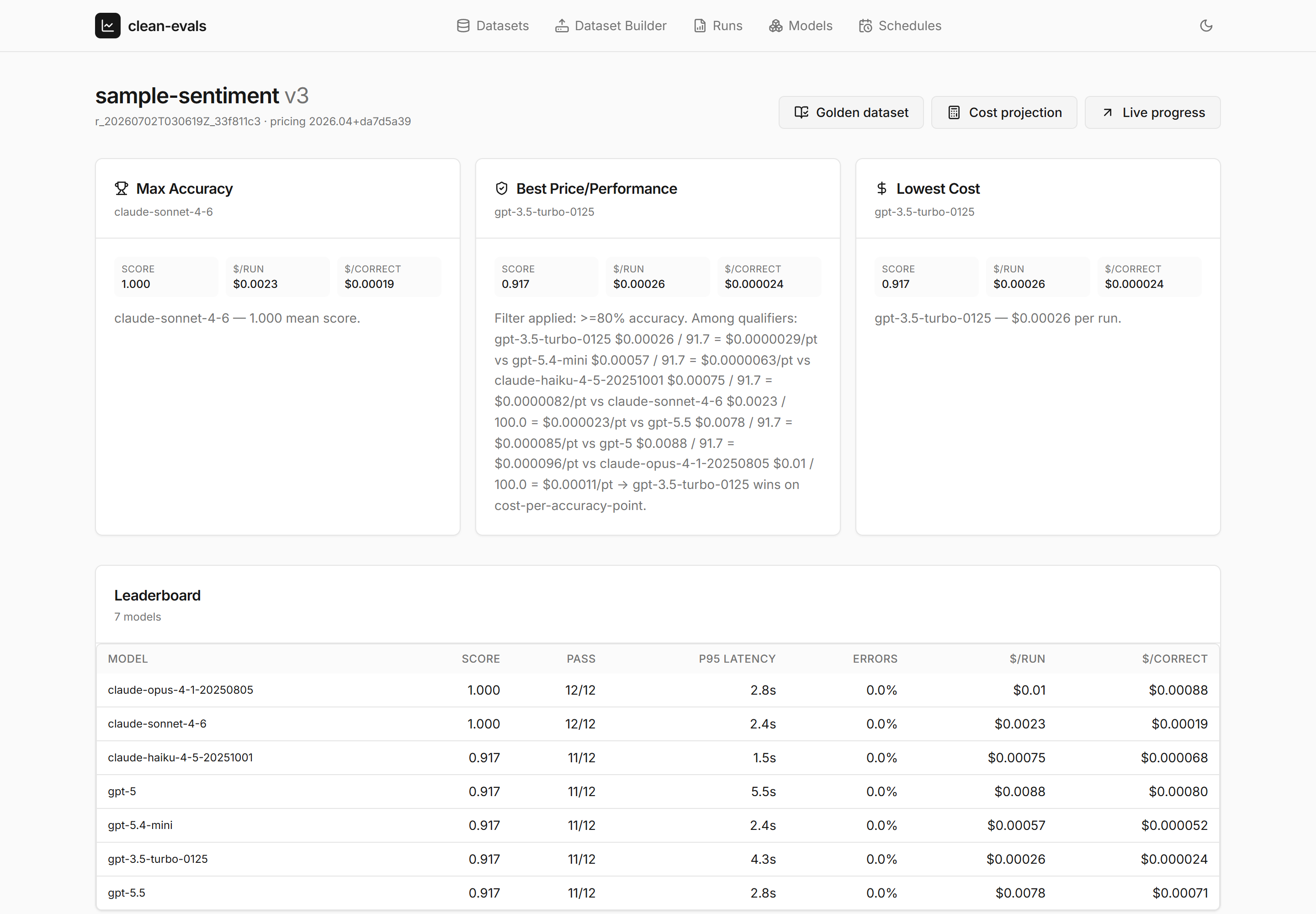
Decision UI — shows three model recommendations per run (max accuracy, best price/performance, lowest cost) with the comparison math, plus per-case heatmaps and cost projections.
-
Telemetry — ingest production interactions (the request, the response, and what the user did next); each derives into a pre-rated candidate case for the golden dataset, and the same signals feed per-model quality monitoring over time.
Quick start
pip install clean-evals
clean-evals migrate
export ANTHROPIC_API_KEY=...
export OPENAI_API_KEY=...
clean-evals run examples/sentiment/dataset.yml \
  --models claude-3-5-sonnet-20241022,gpt-4o-mini-2024-07-18 \
  --max-cost 0.50
clean-evals serve   # http://localhost:8080
Full walk-through: Getting started.
Design principles
- Strictly typed Python.
mypy --strict, noAny, no metaclasses. - Pure-async core. Adapters and the runner are
async-native. - Explicit config. Pydantic with
extra="forbid". Datasets are static documents with no env-var interpolation and no template engine. - Failure is data. A model erroring on a case produces a
CaseResultwithstatus="error"; the run continues. - Determinism by default. With
temperature=0+ a seeded provider, the same dataset + same models produce byte-identical scored output. - Inspectable results. Readable source, plugin extension points, and dated model snapshots, so results trace back to the exact model that produced them.
Architecture
flowchart LR
    CLI[CLI: serve, run,<br/>worker, build] --> Q[Celery + Redis]
    Web[Web UI<br/>FastAPI + React] --> Q
    Q --> Workers[Async runner]
    Workers --> Adapters[Anthropic, OpenAI, Google,<br/>OpenRouter, local OpenAI-compatible]
    Workers --> DB[(MySQL or<br/>Postgres)]
    Workers --> Art[Artifact store<br/>local filesystem]
Adapters --> Models([LLM providers])License
Copyright (c) 2026 datathere.
clean-evals is open source under the GNU AGPL-3.0. You may use, modify, and redistribute it under the license terms, including commercially. The AGPL's copyleft applies: if you modify clean-evals and make it available to others, including over a network, you must make your modified source code available under the same license.
Commercial licenses are available for organizations that cannot accept
the AGPL's obligations. Contact licenses@datathere.com.
The "clean-evals" and "by datathere" marks are governed by the Brand Use Policy; the in-product attribution is a protected legal notice under section 7(b) of the license and must remain intact.